Results from more than 50 million button presses reveal surprising word-order patterns, feline affection, and America’s “talking pet” capital.
SAN DIEGO, CA, UNITED STATES, September 14, 2026 /EINPresswire.com/ — A human baby’s first word might be “Mama” or “Dada.” Your dog? They have other priorities.
FluentPet, maker of recordable sound button systems that let pets communicate with their families, shared findings from its growing community of “talking” animals. Based on more than 50 million button presses, the results reveal differences in how dogs and cats use their first words and patterns in how they combine them.
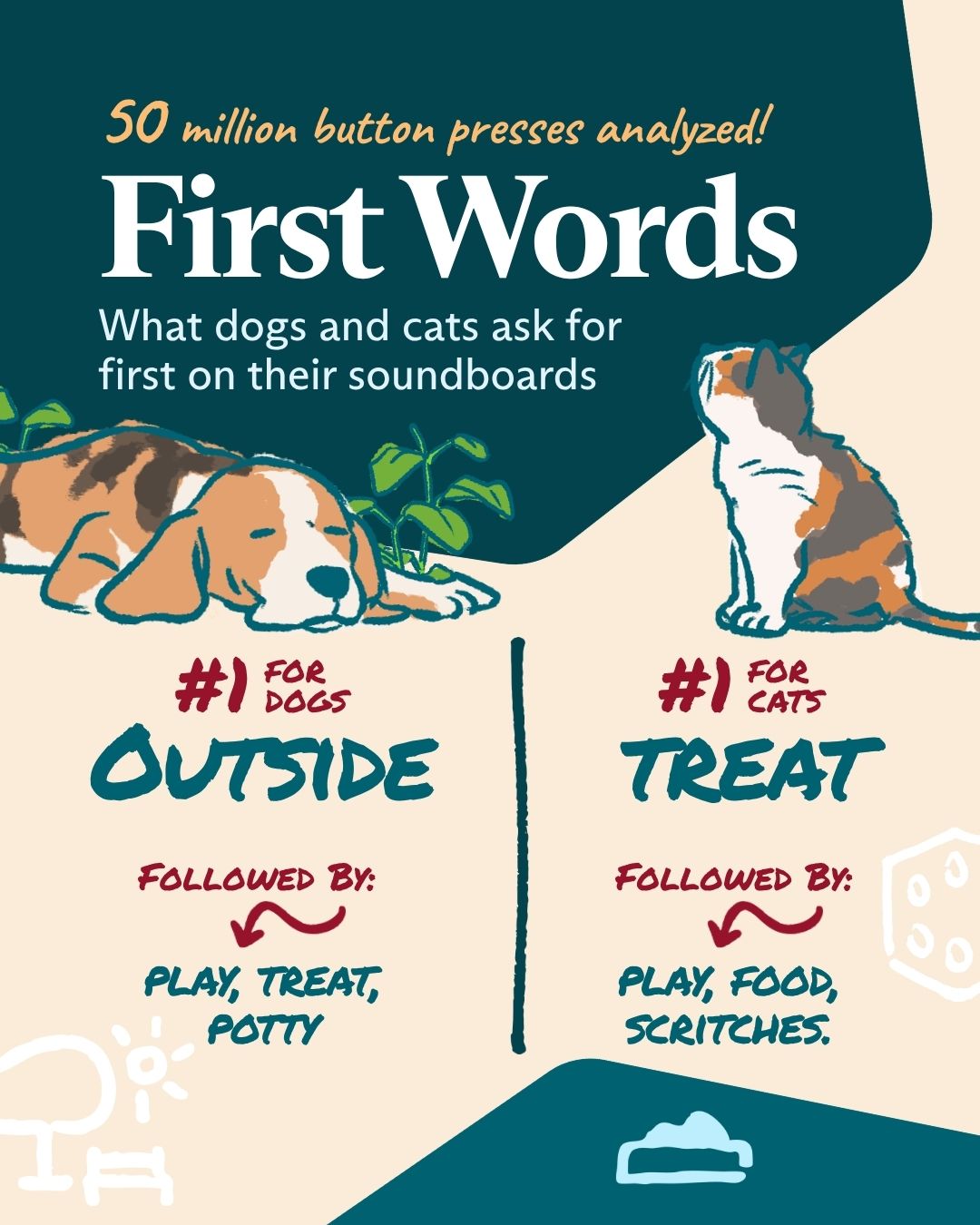
Analyzing approximately 1,550 dogs and 610 cats, FluentPet found the most common first button word for dogs is “outside.” For cats, it’s “treat.”
To separate an emerging pattern from a pet investigating a new toy, FluentPet defined a “first word” as the first button a learner used on three separate days.
For dogs, “outside” ranked first, followed by “play,” “treat,” “potty,” and “food.” Cats were even more focused: “treat” led, followed by “play,” “food,” and “scritches” / “scratches.”
Names like “Mom” and “Dad” accounted for about 5% of pets’ first three words. Cats dismissed their aloof stereotype. Words like “scratches,” “brush,” and “cuddle” made up 16% of their early vocabulary.
While these findings reflect animals’ choices and the buttons humans give them—which usually start with practical needs—the data points to a shift in how we understand the animals we live with.
“After getting FluentPet into hundreds of thousands of households, we learned that what people love most are those ‘AHA!’ moments when their dog or cat figures out how to ask for exactly what they want,” said Leo Trottier, FluentPet’s CEO and founder. “For a long time, the pet industry hasn’t fully taken seriously the idea that dogs and cats possess vivid mental lives. By giving them a toolset to express themselves, we are finally discovering what companion animals can really do.”
MOM, LOVE YOU: SURPRISING WORD-ORDER PATTERNS
As pets learn multiple buttons, FluentPet’s results show they don’t just mash them at random. They combine words in consistent ways.
When pets have access to “Mom” and “love you,” “Mom” comes first in 72% of households. “Mom, love you” is far more common than “love you, Mom.”
Time-related words show the opposite pattern. “Now” appears second 64% of the time, producing combinations like “food, now,” “outside, now,” and “play, now.” “Later” follows the same pattern. Names tend to come first, while time words come last.
“We have to be careful not to mistake what is easiest to observe for what is actually happening in an animal’s mind,” noted Trottier. “It’s tempting to project human grammar onto these button presses. But the fact that we see such consistent patterns across thousands of learners shows this isn’t just random behavior. We are finally able to explore the neglected questions of how animals think, reason, and string concepts together.”
SEATTLE: AMERICA’S TALKING-PET CAPITAL
Seattle is the talking-pet capital of America.
Based on FluentPet’s U.S. web-store customer data, Seattle has more FluentPet households than Los Angeles despite having roughly one-fifth the population. That gives Seattle approximately five times L.A.’s per-capita rate, with Portland third among major cities.
California holds the largest share of U.S. customers at 15.5%. Adjusted for population, the Pacific Northwest leads. Washington has FluentPet households at 2.7 times the national per-capita rate, followed by Oregon at 2.5 times, then Colorado, Utah, and Massachusetts. (This analysis excludes Amazon purchases, which represent a significant portion of U.S. sales).
A NEW WINDOW INTO ANIMAL POTENTIAL
FluentPet’s system allows people to record words onto individual buttons, letting dogs, cats, and other animals begin with simple concepts before moving to names, places, emotions, and time words.
As the community grows, it provides a real-world look at questions nearly impossible to study at scale a few years ago. Do cats and dogs use the same vocabulary differently? Does word order naturally emerge? What happens when animals are given concepts like “now” or “love”?
Sometimes, the answer is complex. Other times, your dog just really wants to go outside.
ABOUT FLUENTPET:
FluentPet develops tools and educational resources that help people communicate with animals. Its recordable sound-button systems help dogs, cats, and other animals associate words with needs, activities, people, and concepts, offering new insight into how companion animals think, learn, and communicate. Visit fluent.pet.
Jake Duhaime
CleverPet, Inc.
+1 617-285-8087
email us here
Visit us on social media:
Instagram
YouTube
TikTok
X
Legal Disclaimer:
EIN Presswire provides this news content “as is” without warranty of any kind. We do not accept any responsibility or liability
for the accuracy, content, images, videos, licenses, completeness, legality, or reliability of the information contained in this
article. If you have any complaints or copyright issues related to this article, kindly contact the author above.

Media gallery