
NEW ORLEANS, Aug. 05, 2026 (GLOBE NEWSWIRE) — The Transportation Institute (TI), representing U.S.-flag American shipping companies, joined farmers, millers, longshoremen, merchant mariners, the U.S. Department of Agriculture, and the World Food Programme (WFP) today at the Port of New Orleans to mark the latest Food for Peace shipment of American-grown grain bound for Kenya.
The U.S.-flagged LIBERTY GRACE loaded 28,420 metric tons of Louisiana Rice in New Orleans. The vessel will take on American-grown wheat in Houston before departing with enough food to feed more than 1 million people facing hunger for an entire year. Kenya is confronting one of its worst food security crises in years, with more than 3.3 million people currently experiencing crisis-level or worse food insecurity.

From left to right: Chris Westbrook (Vice President, Gulf Coast, Seafarers International Union), William Campbell (Executive Vice President, Liberty Maritime), Lisa Burley (Office of Cargo and Commercial Sealift, U.S. Maritime Administration), Captain Willie Barrere (President, American Maritime Officers), John Owen (Louisianan Rice Farmer and Chairman of USA Rice), Michelle Bekkering (USDA Under Secretary for Trade and Foreign Agricultural Affairs), Dr. Mike Strain (Commissioner, Louisiana Deptartment of Agriculture), Matthew Nims (Washington Office Director, World Food Programme), and Beth Brach (CEO, Port of New Orleans). (Credit: Transportation Institute)
The event commemorated the restoration of Food for Peace under the leadership of USDA, which assumed administration of the program in 2025. For more than 70 years, Food for Peace has connected American agriculture with humanitarian assistance around the world, helping people affected by some of the world’s most severe hunger crises through partners like WFP. Louisiana plays a distinct role in that mission as both a leading agricultural producer and a major export gateway to deliver lifesaving food around the world.
“In addition to the important work Food for Peace does providing crops to those in need, it also supports America’s maritime workforce. From seed to ship, there are tens of thousands of people who make this program possible, each one of them critical to our own national security and economic prosperity,” said Sara Fuentes, President, Transportation Institute. “Those voyages keep American mariners sailing, preserve the skills of our Merchant Marine, and ensure our nation has the maritime capacity it will need when called upon.”
“The shipment we’re sending to help those in dire need around the world is a testament not only to the abundance of U.S. agriculture, but more importantly, to the generosity of the American farmer and the bounty they produce,” said USDA Deputy Under Secretary for Trade and Foreign Agricultural Affairs Michelle Bekkering. “This massive shipment also showcases the strength of our historic partnership with U.S. commodity groups, our friends at our merchant marine workforce, and the World Food Programme. Together, we’re helping those in need today and fostering true self-reliance tomorrow. Through our suite of USDA food assistance programs, we’re not just saving lives, we’re changing them.”
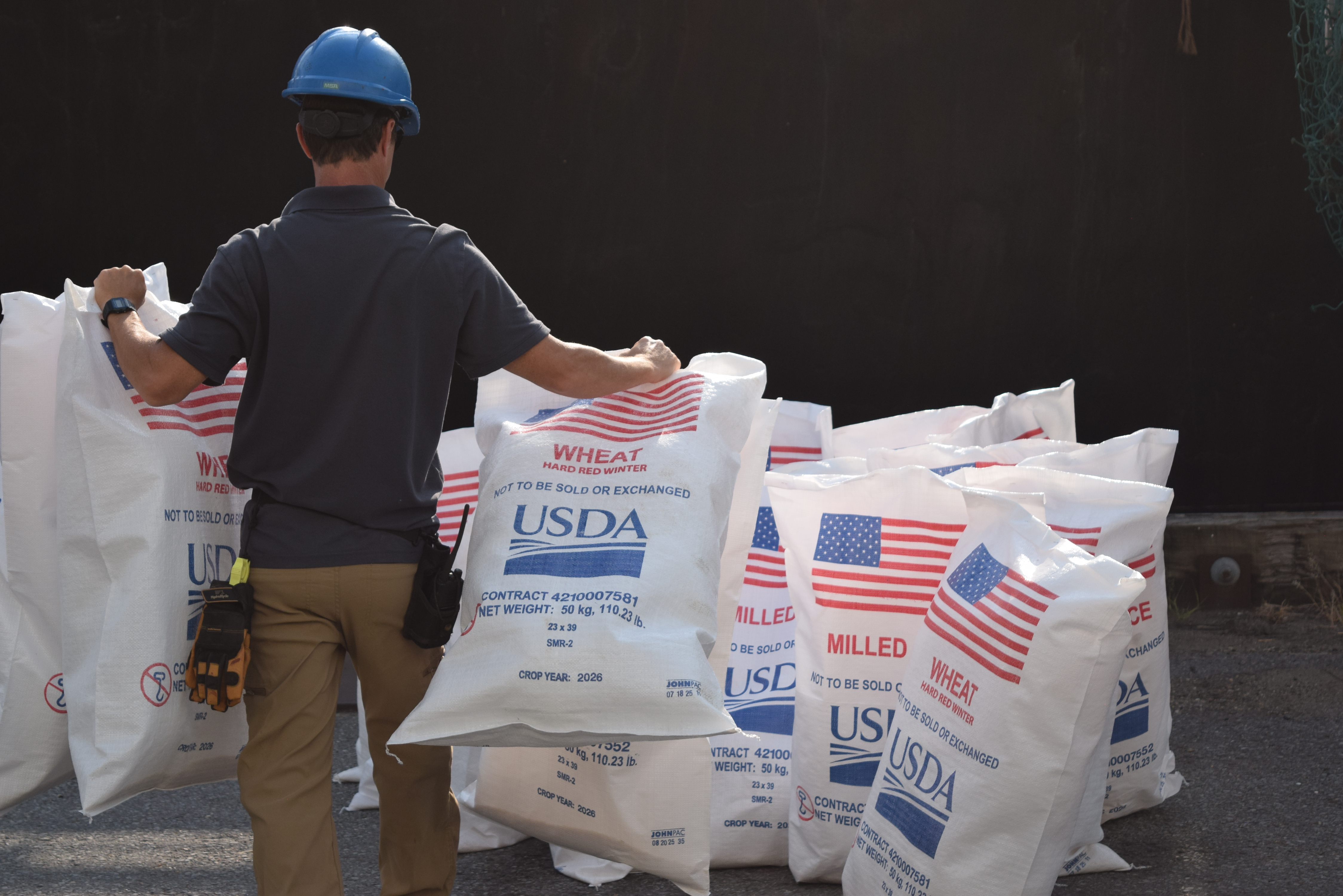
A mariner sets down bags of cargo destined for Kenya (Credit: Transportation Institute)
The vessel is operated by Liberty Maritime Corporation, which operates one of the largest U.S.-flag commercial fleets participating in government cargo preference programs.
“The world needs our help, and with our resources and generosity as Americans, we can do that,” said William Campbell, Executive Vice President of Operations, Liberty Maritime. “Our long-term partnership with Food for Peace has given us the opportunity to see just how much good American farmers bring to the world. We are honored to help make food aid shipments abroad possible, helping millions of people suffering from food insecurity through the unmatched partnership of American farmers and the U.S.-flagged fleet.”
“In a world of plenty, no one should go to bed hungry,” said Matthew Nims, Director, World Food Programme Washington Office. “For more than 60 years, WFP has partnered with the U.S. government and Food for Peace, bringing American-produced, life-saving food and nutrition to hungry communities around the globe. Over the past decade, nearly $5 billion in food has been purchased from U.S. farmers and producers through Food for Peace and donated to WFP to feed the hungry. The U.S. government through USDA, along with farmers, producers, shippers and port workers, are helping WFP save lives, and together, we are building a more stable and food-secure future for all.”
“Rice is the most widely consumed grain in the world, and these 28,420 metric tons of Louisiana rice will play a vital role in helping feed those facing famine,” said USA Rice Chair and Louisiana rice farmer John Owen. “At a time when our rice markets are in dire need, this in-kind commodity donation is a shot in the arm for our industry and makes us more optimistic about the future of Food for Peace under USDA’s leadership. As Congress continues to debate the farm bill, we encourage them to make permanent the transfer of this program to USDA to ensure it can continue delivering American-grown commodities to families facing food insecurity around the world.”
“Wheat farmers have championed U.S. food aid assistance for more than 70 years, since a northwest Kansas farmer first proposed that sharing abundant harvests could help feed those in need around the world,” said Gary Millershaski, Chairman of U.S. Wheat Associates and Kansas wheat farmer. “Today, we are proud to be here with USDA and support the agency as they take the helm of the Food for Peace program. This bulk vessel will carry U.S.-grown wheat across the ocean to help feed hungry families. As a farmer, this echoes the lessons I was taught being raised on the farm: If a neighbor is in need, you lend a helping hand. It’s just what we do.”
The event was live-streamed at https://vimeo.com/event/6068126.
The shipment was loaded entirely by American workers and will be transported aboard a U.S.-flagged merchant vessel, supporting American agriculture, ports and the U.S. Merchant Marine.
About the Transportation Institute (TI)
The Transportation Institute (TI) was established in 1967 as a non-profit organization dedicated to maritime research, education and promotion. The Institute participates in all phases of the nation’s deep-sea, foreign and domestic shipping trades, and barge and tugboat operations on the Great Lakes and on the vast network of America’s inland waterways. Many member company vessels are contracted to the U.S. military services. All are of U.S. registry — crewed by American citizens operating under the world’s highest safety standards, and proudly flying the American flag. With offices on the East and West coasts, the Transportation Institute supports a wide range of programs that promote the strength of America’s capability. For more information, please visit https://transportationinstitute.org/
Contact: TIMedia@nahigianstrategies.com
Photos accompanying this announcement are available at
https://www.globenewswire.com/NewsRoom/AttachmentNg/73d1a7da-3bf9-4214-9171-51dea4d23244
https://www.globenewswire.com/NewsRoom/AttachmentNg/29b408d6-4057-4940-9d9b-9a80a74686c1


