
Originally Posted On: https://www.theboxery.com/blog/how-to-switch-from-plastic-clamshells-to-recyclable-chipboard-cartons/
What You'll Need
Time required: about 2 to 3 hours of hands-on work, plus a few days for samples to arrive and a test round of shipments.
-
Your product, ready to pack. Grab 3 to 5 units of each item you plan to move out of clamshells: prints, cards, jewelry, flat goods.
-
A ruler or calipers. Measure length, width, and thickness in inches. Add a quarter inch to each side for easy loading.
-
Your current clamshell specs. Note the size and how many you use per month, so you can order the right case count.
-
Sample chipboard cartons. Order a few styles in white and kraft (brown) so you can test the fit by hand before buying wholesale.
-
Protective extras. Chipboard pads, kraft paper, or a bubble wrap roll for items that need cushioning inside the carton.
-
Your outer shipping pack. A poly mailer, bubble mailer, or corrugated mailer. A chipboard carton isn't built to ride alone through the mail.
-
Packing tape and a scale. You'll want to weigh the finished pack and confirm it stays in the same postage tier.
-
A notebook or spreadsheet. Track fit, damage, and pack time for your first 20 to 50 orders.
Skills needed: none beyond basic measuring and folding. If you can fold a gift box, you can do this.
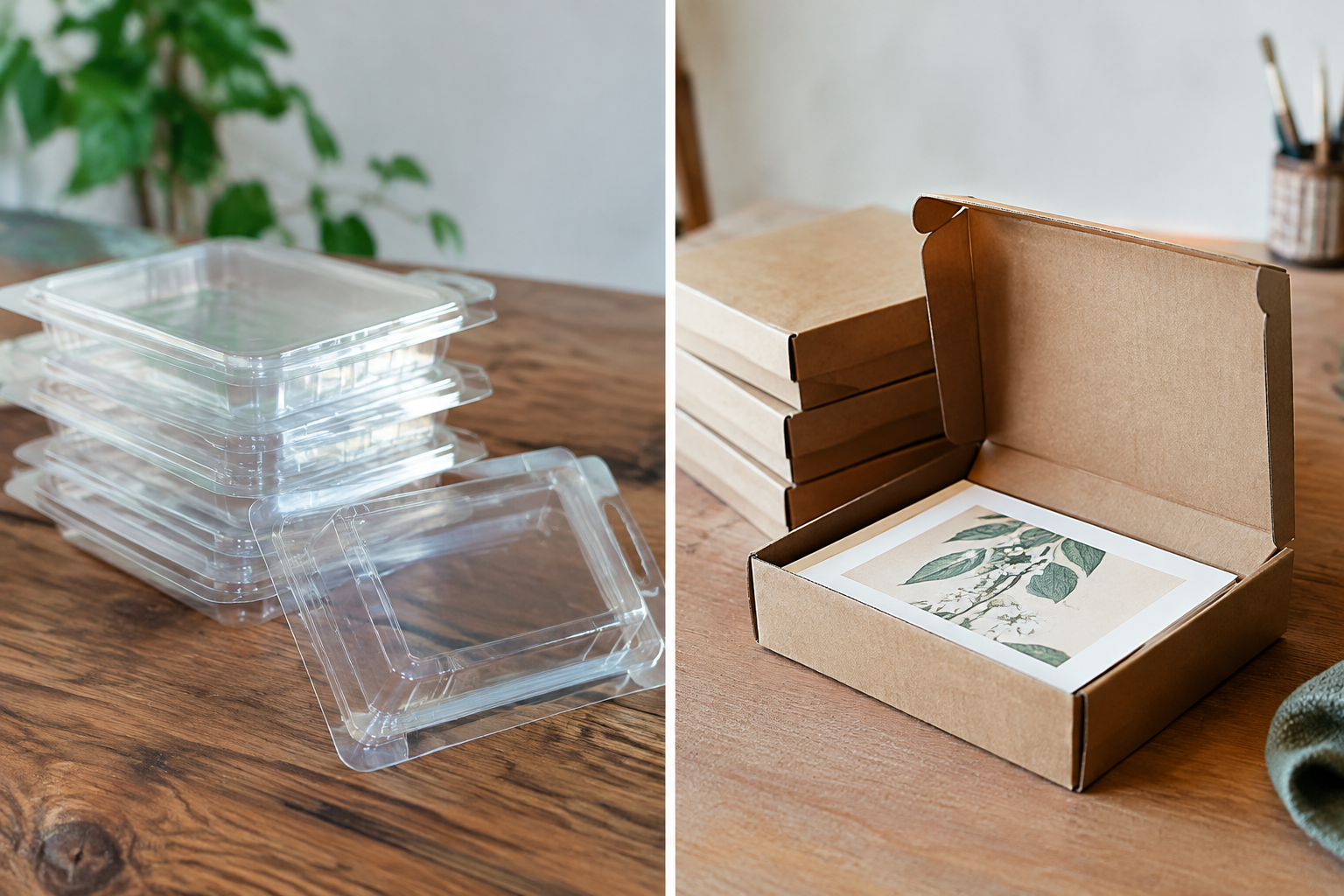
Plastic clamshells crack. They scuff, they won't recycle in most curbside bins, and buyers have started noticing. For sellers shipping prints, cards, and jewelry, that's a problem worth fixing now.
Chipboard cartons are the cleanest swap. They're rigid, flat-packed, printable, and recyclable. A 4×6 print or a small jewelry card sits snug inside, and you're not paying to ship a bulky plastic shell. The catch? Pick the wrong style or thickness and you'll trade cracked plastic for crushed corners. Realistically, the switch takes a few measurements, one small test order, and a handful of pack-out checks.
Third-person guides tend to skip the dull part, so here it is: most failures come from sizing a quarter inch off, not from the board itself. Get the fit right and the rest is easy. So where do you start?
What You'll Get Done and What You Need Before You Start
A seller of lip balm — small soap bars pulls 40 clamshells off the shelf, tallies the returns, and sees the same problem again: cracked hinges, brittle plastic, and customers asking why it isn't recyclable. That's the starting point for this swap. By the end, you'll have a tested, right-sized paperboard carton replacing each clamshell, with no oversized boxes and no guessing.
Materials and measurements to gather first
Don't order anything yet. Measure first.
-
Product dimensions in inches: length, width, height, taken at the widest points.
-
Product weight on a postal scale. Chipboard handles light and medium goods best.
-
Three to five sample items from each product line for fit tests.
-
Insert needs: a paper tray, kraft wrap, or small bubble sleeve if the item is fragile.
-
Shipping method: does the carton go inside a mailer or box, or straight to the customer?
Add about 1/8 inch of clearance per side so the item slides in without rattling. Then compare your numbers against stocked chipboard cartons before considering custom sizes. Flat sellers should also look at Paper mailers as an outer layer, since a carton alone won't survive a postal sorter.
Step 1: Measure Your Product and Pick the Right Chipboard Carton Style
Guessing the size is the fastest way to waste money. Measure the length, width, and thickness of the packed product, then add about 1/8 inch per side so it slides in without rattling. Write the numbers down in inches, in that order, every time.
Chipboard cartons vs. corrugated vs. rigid boxes: which fits flat goods, cards, prints and jewelry
Each style suits a different job.
Here's how the three break down:
-
Chipboard cartons: thin, folding paperboard. Best for cards, small jewelry, and retail display. Light, but they crush under weight.
-
Corrugated: fluted cardboard that resists crushing. Best for heavier items or long transit.
-
Rigid boxes: thick, wrapped gift-style boxes. Great looking. Overkill for most shipping.
For prints — cards, chipboard flat mailers add the stiffness that a plain carton can't. Flat goods under a few ounces rarely need more.
Jewelry is different. A small chipboard carton works as the inner box, but it won't survive the postal system alone. Pair it with an outer shell.
And that's where weight matters. Lightweight mailers hold postage down while still protecting a carton inside.
Rule of thumb: ship in corrugated or a stiff mailer, presented in chipboard.
Step 2: Choose Your Board Finish, Coating, and Add-Ons (White, Kraft, Lids, Inserts)
Which finish actually fits what you sell? Pick that first, because it drives everything else about your chipboard cartons.
Two finishes cover most small-seller needs. White paperboard takes color printing cleanly, so it suits jewelry, cards, and gift sets. Kraft (the natural brown look) reads as handmade and eco-minded, and it hides scuffs better in transit.
Coating
Uncoated board recycles easiest. Skip heavy plastic lamination if your goal is leaving plastic behind. A light water-based coat handles minor moisture and still goes in the recycling bin. Ask your supplier before you order.
Lids and Inserts
-
Lids: Tuck-top or two-piece boxes with lids feel like a gift and stack well.
-
Paperboard inserts: Die-cut or folded dividers hold small items in place, replacing foam trays.
-
Kraft paper wrap: Crinkle fill or tissue covers the gaps. No bubble needed for light goods.
Here's the catch. Chipboard isn't built for rough handling alone. If you ship through the mail, slip the carton inside a mailer for the outer layer. Then close any outer box with packers tape so seams hold.
Order a small sample batch of two finishes first.
Test both.
Step 3: Test, Order a Small Batch, and Pack Your First Orders
Pack-out checks: shipping a chipboard carton inside a mailer or box so it survives transit
A 2-5% damage rate can wipe out the profit on fragile items. Chipboard cartons won't fix that on their own — the shipper around them does.
Chipboard is paperboard, not corrugated. It holds its shape on a shelf but folds under a stack of parcels. So never mail one bare.
Run this test on your first 10 packed orders:
-
Seat the product snugly. Shake the closed carton. No rattle allowed.
-
Seal the lid seam with paper tape so the whole pack stays recyclable.
-
Slide the carton into a corrugated mailer or box with roughly half an inch of room on every side.
-
Fill the gaps with kraft paper, then close the outer shipper with packaging tape.
-
Drop it from waist height onto a flat face, a corner, and an edge.
Open it up. Is the carton crushed? Did the lid pop? If so, move to a thicker board or add a chipboard pad behind the product.
And skip poly mailers for anything rigid (they suit soft goods — a carton inside one gets flattened). Mail a few test orders to yourself or a friend before you commit to the full reorder.
Common Mistakes and Troubleshooting When You Replace Plastic Clamshells
Thinner isn't cheaper. That's the myth that sinks most switches. Sellers grab the lightest paperboard they can find, ship 200 orders, and then wonder why corners are crushed on a third of them.
Here's what actually goes wrong, and how to fix it.
Mistake 1: Picking the Wrong Size
Plastic clamshells forgive a loose fit because the shell is stiff. Chipboard cartons don't. Measure your product, add a quarter inch of play — test one before you buy a case. Rattling means too big. Bulging seams mean too small.
Mistake 2: Skipping Moisture and Crush Checks
Uncoated paperboard softens when it gets damp. Drop a sample in a poly bag for outer protection, then run a drop test from waist height. Fail it? Add a chipboard pad inside for stiffness.
Mistake 3: Using Chipboard Alone for Shipping
Chipboard is a retail carton, not a shipping box. Put it inside something rigid. Flat mailers work well for prints, cards, and other flat goods, and they keep the carton square.
-
Stock a few extras: inserts, pads, and corner boards cost little.
-
Check Packaging accessories before your first full order.
Next Steps: Verify the Switch Worked and Scale Up Your Wholesale Chipboard Order
A seller ships 40 test orders in chipboard cartons on a Monday. By Friday, two customers have replied and one carton has a crushed corner. That's a useful week. It tells you exactly what to fix before you buy a case of 1,000.
Run the test for at least 30 to 50 orders. Then check three things.
-
Damage count. Log every complaint and every crushed carton. Compare it to your old clamshell rate.
-
Fit. Does the product slide or rattle? A loose item means the carton is too big, or it needs a paper or kraft insert.
-
Moisture. Chipboard soaks up water. If a box arrived damp, switch to a coated stock or add an outer wrap.
Heavy or fragile goods still need an outer shipper.
Slip the cartons into poly mailers for light items, or a corrugated box for anything that can break.
Once damage stays flat, scale up. Order in bulk, since wholesale quantities cut the per-carton rate. Start with your top two sizes and keep a small reserve of the rest. Not sure about a size? Ask before you commit to a full case.
How-To FAQ
How long does it take to switch from plastic clamshells to chipboard cartons?
Plan on two to four weeks from first measurement to your first packed orders. Measuring and picking a style takes a day. The sample test takes a few days. Then you wait on a small batch to arrive. Don't skip the sample step to save time (it's where most problems show up).
Is a chipboard carton as protective as a plastic clamshell?
No, not on its own. A clamshell resists crushing and moisture better than a single layer of paperboard. Chipboard cartons are rigid enough to hold flat goods like cards, prints, and light jewelry, but they need an outer shell. Slip the carton inside a corrugated mailer or a box before it ships. Test it with a drop from waist height and see what happens.
Which finish should I pick: white or kraft chipboard?
Pick white if you want to print or stamp a logo in color. Pick kraft (the brown, natural look) if you sell handmade goods and want a plain, earthy feel. Both recycle the same way. Coated board resists scuffs and light moisture, though a heavy coating can limit recycling, so ask the supplier what's on the board.
Do I need lids or inserts?
It depends on what's inside. Jewelry usually needs a lid — a small insert so nothing slides around. Flat prints and cards often do fine in a simple tuck-style carton with a chipboard pad behind them. If an item shifts when you shake the carton, add an insert.
What's the most common mistake when replacing clamshells?
Ordering the wrong size. People measure the product but forget the thickness of the board and any insert. Add a little room on each side, then test with your real product. Order a small batch first, not a full wholesale case.
Can I buy chipboard cartons in small quantities?
Yes. Start with a sample set or one case, pack 20 to 30 orders, and track any damage. If your damage rate holds steady, move up to a bigger order. That keeps cash and storage space from getting tied up in cartons that might not fit.
Dropping plastic clamshells doesn't have to mean taking on more damage or higher shipping bills. Sellers who make the change well tend to follow the same pattern. They measure the product first, pick a carton style that fits it snugly — test before committing to volume.
The fit matters more than the material.
A snug carton keeps prints from bending, cards from sliding, and jewelry from rattling, and it keeps the package light and thin enough to avoid dimensional weight surprises. Pair the carton with a sturdy mailer or a right-sized box, and transit damage stays low. Skip that outer layer, and no board finish will save the order.
Recyclable chipboard cartons also give a seller something clamshells never did: a printable, kraft or white surface that looks like a brand rather than a cheap wrapper. Customers notice. They tend to recycle it, too.
So here's the next step. Pull five of your best-selling items, measure each one — order a small test batch of chipboard cartons in the two closest sizes. Ship ten real orders, track what comes back, and scale to a case order only when the damage count stays at zero. The Boxery's team can help with sizing through live chat or email.