Articulated Robot Market Size, Share and Research Report By Payload Capacity (Up To 16 Kg, 16–60 Kg, 60–225 kg, Above 225 kg), By Axis Type (4-Axis, 5-Axis)
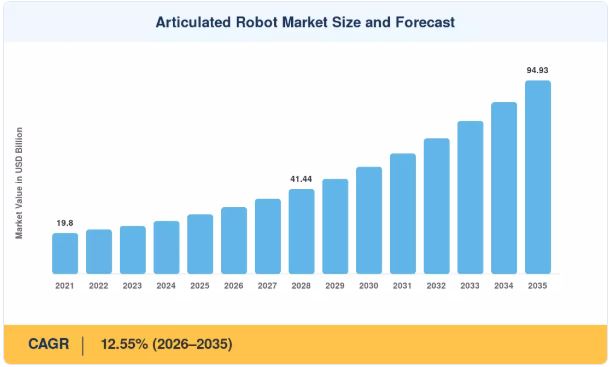
NEW YORK,, NY, UNITED STATES, September 2, 2026 /EINPresswire.com/ — The Global articulated robot market reached an estimated USD 29.05 billion in 2025 and is projected to grow from USD 32.70 billion in 2026 to USD 94.93 billion by 2035, registering a CAGR of 12.55% during the forecast period. Two major catalysts are accelerating this trajectory: the intensifying global labor shortage across manufacturing and logistics sectors that has compelled automakers, electronics assemblers, and food processors to fast-track robotic automation investments, and the rapid maturation of collaborative robot (cobot) technology that is now enabling safe human–robot interaction on shared assembly floors without the need for traditional safety caging. With over USD 2.1 trillion in global manufacturing capex earmarked for automation and smart factory initiatives through 2035, industrial operators face mounting pressure to deploy flexible, multi-axis articulated robotic systems or risk acute competitiveness erosion.
Legacy fixed-sequence automation many systems built around single-purpose pneumatic actuators and PLC-controlled transfer lines are rapidly giving way to 6-axis and 7-axis articulated robots that integrate AI-driven vision systems, force-torque sensing, and cloud-connected predictive maintenance platforms. A recent McKinsey Global Institute analysis estimated that top-quartile manufacturers deploying articulated robotic arms alongside machine vision and digital twin technologies achieved 31–37% higher throughput per worker than peers still relying on legacy hard automation. This technology shift is not incrementalit represents a structural re-platforming of how the entire manufacturing sector approaches precision, flexibility, and scalable production.
Get Full PDF Sample Copy of Report: (Including Full TOC, List of Tables & Figures, Chart) @
https://www.marketresearchfuture.com/sample_request/6805
➤ How Significant Is the Articulated Robot Market’s Growth?
The articulated robot market has demonstrated consistent and robust expansion, rising from approximately USD 12.88 billion in 2021 to an estimated USD 29.05 billion in 2025, representing a healthy historical growth trajectory. The market is expected to more than double over the next decade, driven by accelerating adoption across automotive, electronics, food & beverage, pharmaceuticals, and logistics end-use verticals, alongside the rapidly declining cost-per-unit of industrial robotic arms and the explosion of plug-and-play cobot deployments targeting small and mid-sized manufacturers.
Rising e-commerce fulfillment volumes, near-shoring and reshoring of strategic manufacturing capacity, and increasingly stringent worker safety regulations are creating acute demand for automated articulated robotic solutions. Automotive OEMs, semiconductor fabs, contract electronics manufacturers, and third-party logistics providers are all investing heavily in next-generation articulated robot fleets to reduce cycle times, eliminate repetitive strain injuries, and achieve the flexible production changeovers demanded by modern just-in-time supply chains.
➤ What Does the Future Hold for the Articulated Robot Market?
Artificial intelligence and advanced sensing technologies stand at the forefront of the market’s next growth phase. AI-enabled articulated robots are transforming industrial automation from rigid, pre-programmed routines into adaptive, context-aware systems capable of handling unstructured tasks, variable part geometries, and real-time process deviations. Vision-guided pick-and-place systems, force-torque-controlled assembly, and reinforcement-learning-based robot programming are becoming standard capabilities rather than premium differentiators.
The growing emphasis on human–robot collaboration is another defining force shaping the market’s future. ISO/TS 15066-compliant collaborative articulated robots are now deployable alongside human workers across assembly, quality inspection, and material handling tasks dramatically expanding the addressable automation footprint in factories where traditional caged robots were impractical. Platforms offering intuitive hand-guided programming, drag-and-drop task sequencing, and built-in collision detection are removing historic barriers to robotic adoption among small and mid-sized manufacturers.
Digital twin integration and cloud-connected robot fleet management are also redefining the operational model. Manufacturers can now simulate articulated robot cell deployments in virtual environments before physical installation, optimizing cycle times, identifying collision risks, and validating safety zones reducing commissioning time by up to 40% according to recent FANUC and Siemens Digital Industries case studies. Remote diagnostics, OTA firmware updates, and predictive maintenance alerts are further reducing unplanned downtime and total cost of ownership.
Buy this Premium Research Report at:
https://www.marketresearchfuture.com/checkout?currency=one_user-USD&report_id=6805
➤ Who Are the Key Players in the Articulated Robot Market?
The articulated robot landscape is characterized by a mix of established industrial automation giants, specialized collaborative robot developers, and emerging AI-native robotics startups. Key participants shaping the competitive dynamics include:
★ FANUC Corporation — the world’s largest industrial robot manufacturer, offering an extensive articulated robot portfolio spanning micro-payload to ultra-heavy-duty applications
★ KUKA AG — delivering advanced articulated robots for automotive, aerospace, and general industry, with deep expertise in robotic welding, assembly, and material handling
★ ABB Robotics — providing a comprehensive family of articulated robots from collaborative cobots to high-speed industrial arms, backed by AI-powered robot programming tools
★ Yaskawa Electric Corporation — offering the Motoman series of articulated robots with broad application coverage across welding, painting, packaging, and semiconductor handling
★ Kawasaki Robotics — specializing in high-speed, high-payload articulated arms for automotive assembly, logistics, and pharmaceutical automation
★ Mitsubishi Electric Corporation — delivering MELFA-series articulated robots with compact footprints and advanced vision integration for electronics and precision assembly
★ Universal Robots — pioneering the collaborative robot category with its UR-series cobot arms, now the world’s best-selling collaborative robot platform
★ Staubli Robotics — specializing in high-speed, hygienic-design articulated robots for food processing, pharmaceuticals, and cleanroom semiconductor applications
★ Epson Robots — offering compact, high-precision articulated robots optimized for electronics assembly, medical device manufacturing, and laboratory automation
★ Doosan Robotics — providing next-generation collaborative articulated robots with advanced force sensing and intuitive programming interfaces for flexible manufacturing
Competition in the market is intensifying as vendors race to embed generative AI and natural language programming interfaces, expand cobot payload and reach envelopes, and deepen integrations with MES, ERP, and digital twin platforms. Strategic partnerships with machine vision providers, end-of-arm tooling specialists, and systems integrators are also reshaping the competitive landscape as robotics ecosystems become the primary differentiator over individual robot specifications.
➤ What Are the Emerging Trends in the Articulated Robot Market?
Several transformational trends are redefining how the articulated robot market evolves through 2035:
AI & Vision-Guided Autonomy: Deep learning-based 3D vision systems enabling robots to identify, locate, and handle randomly oriented or deformable objects are transitioning from R&D projects to production deployments unlocking automation in previously intractable tasks such as bin-picking, flexible part assembly, and quality defect detection.
Collaborative Robot (Cobot) Proliferation: ISO/TS 15066-compliant cobot arms are expanding the automation addressable market into SME factories, research laboratories, retail fulfillment centers, and healthcare settings where traditional caged robots were impractical due to space, cost, or safety constraints.
Mobile Manipulation & AMR Integration: Articulated robot arms mounted on autonomous mobile robot (AMR) bases are creating mobile manipulation platforms capable of traversing dynamic factory floors, fetching components, and performing assembly or inspection tasks at multiple workstations dramatically increasing deployment flexibility.
Digital Twin & Simulation-First Deployment: Virtual commissioning using physics-accurate robot simulation environments (RobotStudio, KUKA.Sim, FANUC ROBOGUIDE) is becoming the standard pre-deployment workflow, reducing physical setup time, validating safety zones, and enabling rapid production line reconfigurations without line stoppages.
Low-Code & Natural Language Robot Programming: Intuitive graphical, hand-guided, and increasingly natural-language programming interfaces are democratizing robotic deployment, enabling production engineers and line operators to program and retask articulated robots without specialized robotics engineering expertise.
Sustainability & Energy-Efficient Robotics: Next-generation articulated robots featuring regenerative drive systems, lightweight carbon-fiber arm structures, and AI-optimized motion planning are delivering 25–40% reductions in per-cycle energy consumption — supporting manufacturer ESG commitments and reducing operating costs simultaneously.
Get access to the full description of the report @
https://www.marketresearchfuture.com/reports/articulated-robot-market-6805
➤ How Is the Articulated Robot Market Segmented?
The articulated robot market report provides a comprehensive segmentation framework:
1 By Payload Capacity: Up to 16 kg, 16–100 kg, Above 100 kg
2 By Axis Configuration: 4-Axis, 6-Axis, 7-Axis & Above
3 By Application: Welding & Soldering, Material Handling, Assembly, Painting & Dispensing, Machine Tending, Quality Inspection
4 By End-Use Industry: Automotive, Electronics & Semiconductors, Food & Beverage, Pharmaceuticals & Healthcare, Aerospace & Defense, Logistics & E-Commerce
5 By Type: Traditional Industrial Robots, Collaborative Robots (Cobots), Mobile Manipulation Platforms
➤ What Are the Regional Insights from the Articulated Robot Market?
Asia-Pacific dominates the global articulated robot market with approximately 68% of worldwide industrial robot installations, driven by China’s massive ongoing smart manufacturing push under its “Made in China 2025” successor initiatives, Japan’s globally dominant robot manufacturing ecosystem, and South Korea’s hyper-automated semiconductor and display panel fabrication sector. China alone accounted for over 70% of all new robot installations across APAC in 2024, with domestic vendors including SIASUN, ESTUN, and Inovance increasingly challenging established Japanese and European brands on price-performance metrics.
Europe holds the second-largest share at approximately 16%, with Germany, Italy, France, and Sweden representing the primary markets. Germany’s automotive manufacturing cluster home to BMW, Mercedes-Benz, Volkswagen, and their extensive tier-1 supplier ecosystems remains one of the world’s most robotically intensive production environments. European Union industrial policy initiatives supporting manufacturing digitalization and near-shoring of strategic supply chains are creating additional demand vectors for articulated robotic systems.
North America represents a rapidly accelerating region, driven by the CHIPS and Science Act-funded semiconductor fab buildout across the United States, the reshoring of EV battery and automotive assembly capacity, and surging e-commerce logistics automation investments. The U.S. robot density currently at 285 robots per 10,000 workers remains significantly below South Korea (1,012) and Germany (415), underscoring the substantial catch-up automation potential that remains untapped across American manufacturing.
South America and the Middle East & Africa round out the global picture, with Brazil, Mexico, Saudi Arabia, and the UAE representing the most active markets. Mexico’s near-shoring boom fueled by automotive and electronics manufacturers relocating capacity from Asia is generating particularly strong demand for articulated welding and assembly robots across the country’s northern industrial corridors.
➤ FAQ
Q – How do leasing and Robot-as-a-Service models affect total cost of ownership?
A – RaaS converts upfront capital into per-unit or per-hour fees, reducing first-year cash outlay by 60–80%. Over a five-year horizon, however, cumulative lease costs can exceed outright purchase by 15–25%
Q – What maintenance intervals are typical for industrial articulated robots?
A – Major servicing — grease replacement, belt inspection, battery swap — is recommended every 8,000–12,000 operating hours. Predictive-maintenance software can extend intervals by 20–30% through condition-based scheduling
➤➤➤ Industry Analysis Reports by Market Research Future:
Heat-Assisted Magnetic Recording Device Market-
https://www.marketresearchfuture.com/reports/heat-assisted-magnetic-recording-device-market-10663
Semiconductor Foundry Market-
https://www.marketresearchfuture.com/reports/semiconductor-foundry-market-10750
It Asset Reuse Market-
https://www.marketresearchfuture.com/reports/it-asset-reuse-market-10935
Non-Destructive Inspection Equipment Market-
https://www.marketresearchfuture.com/reports/non-destructive-inspection-equipment-market-11068
Network Engineering Services Market-
https://www.marketresearchfuture.com/reports/network-engineering-services-market-11087
Travel Insurance Market-
https://www.marketresearchfuture.com/reports/travel-insurance-market-11161
Intruder Alarm System Market-
https://www.marketresearchfuture.com/reports/intruder-alarm-system-market-11504
Refurbished Smartphone Market-
https://www.marketresearchfuture.com/reports/refurbished-smartphone-market-11690
Signal Generators Market-
https://www.marketresearchfuture.com/reports/signal-generators-market-11736
Fintech Technologies Market-
https://www.marketresearchfuture.com/reports/fintech-technologies-market-11881
Market Research Future
Market Research Future
+1 855-661-4441
email us here
Legal Disclaimer:
EIN Presswire provides this news content “as is” without warranty of any kind. We do not accept any responsibility or liability
for the accuracy, content, images, videos, licenses, completeness, legality, or reliability of the information contained in this
article. If you have any complaints or copyright issues related to this article, kindly contact the author above.

Media gallery