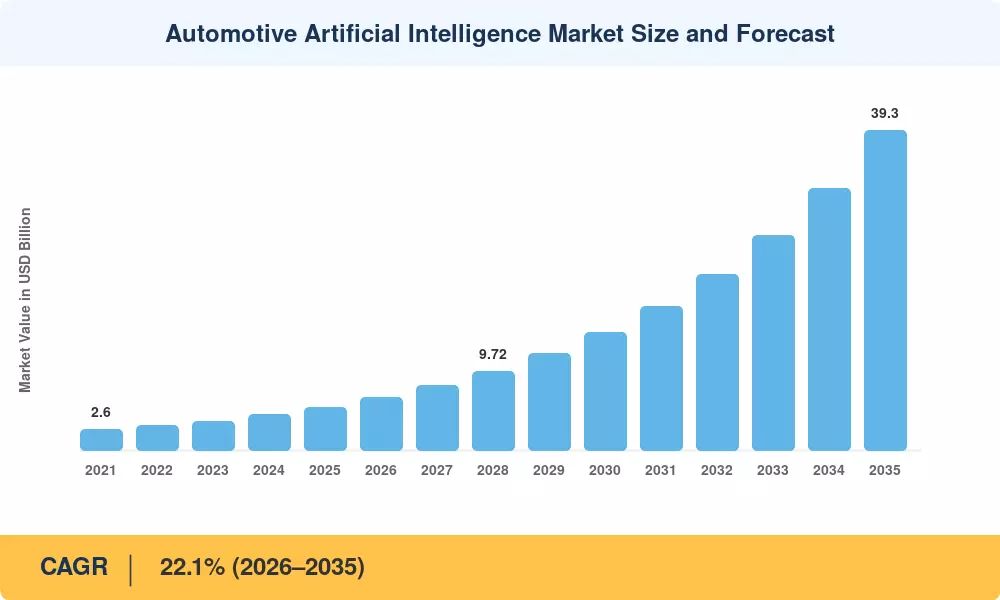
Automotive Artificial Intelligence Market is projected to reach USD 6.52 billion in 2026 before climbing to USD 39.30 billion by 2035.
NEW YORK, NY, UNITED STATES, August 21, 2026 /EINPresswire.com/ — According to a study from Market Research Future, Automotive Artificial Intelligence Market is projected to reach USD 6.52 billion in 2026 before climbing to USD 39.30 billion by 2035, registering a CAGR of 22.1% during the forecast period (2026–2035).
Market Overview
The Automotive Artificial Intelligence Market represents one of the most transformative and rapidly expanding segments within the global automotive industry, encompassing the development, deployment, and integration of AI technologies across the entire automotive value chain. Automotive artificial intelligence encompasses a comprehensive range of technologies including machine learning, deep learning, computer vision, natural language processing, and neural networks, all applied to enhance vehicle safety, autonomy, personalization, and operational efficiency. These AI technologies are deployed across various automotive applications, from advanced driver-assistance systems and autonomous driving to predictive maintenance, voice assistants, and intelligent manufacturing processes, fundamentally reshaping how vehicles are designed, manufactured, operated, and maintained.
The market’s exceptional growth trajectory at a compound annual growth rate of 22.1% is underpinned by several powerful drivers. The most significant driver is the accelerating transition toward autonomous vehicles, which rely heavily on AI technologies for perception, decision-making, and control. AI is essential for processing the vast amounts of sensor data from cameras, radar, lidar, and other sensors, enabling vehicles to understand their environment and make safe driving decisions. The increasing sophistication of ADAS features, which are becoming standard equipment across vehicle segments, drives substantial demand for AI-powered perception and decision-making systems. Furthermore, the growing consumer expectation for personalized, intuitive, and connected vehicle experiences has accelerated AI adoption in areas such as voice recognition, natural language interaction, and predictive personalization.
Several significant industry trends are reshaping the Automotive Artificial Intelligence landscape. The trend toward centralized computing architectures in vehicles, where powerful domain controllers and central computers handle AI processing, is enabling more sophisticated AI applications while reducing complexity and cost. The emergence of generative AI technologies, including large language models and multimodal AI, is opening new possibilities for human-vehicle interaction, enabling more natural and context-aware communication between drivers and their vehicles. The trend toward edge AI, where processing occurs on the vehicle rather than in the cloud, is enabling real-time AI applications with low latency, crucial for safety-critical functions such as autonomous driving and collision avoidance.
Technological developments in the automotive AI sector are advancing at remarkable speed. Deep learning algorithms continue to evolve, with architectures such as transformers and vision transformers achieving state-of-the-art performance in perception tasks. The development of more efficient AI models, through techniques such as model compression, quantization, and pruning, is enabling the deployment of sophisticated AI capabilities on resource-constrained automotive hardware. Federated learning, where AI models are trained across distributed vehicles while preserving privacy, is emerging as a promising approach for improving AI models with real-world data. Neuromorphic computing, which mimics the architecture of biological neural networks, offers potential for ultra-low-power AI processing in automotive applications.
Government policies and regulatory frameworks are playing an increasingly important role in shaping the Automotive AI market. Regulatory frameworks for autonomous vehicles are evolving, with governments in major markets establishing standards and requirements for AI-based autonomous systems. Safety regulations and testing requirements for ADAS and autonomous driving systems are driving investment in AI capabilities that can meet rigorous safety standards. Government funding and incentives for AI research and development, particularly in areas such as autonomous driving and intelligent transportation systems, are accelerating innovation in the automotive AI sector. Furthermore, data privacy and protection regulations are influencing how AI systems are developed and deployed, particularly in areas such as in-cabin monitoring and personalized services.
The demand outlook for automotive AI solutions remains exceptionally strong, with projections indicating sustained rapid growth throughout the forecast period. The increasing electrification of vehicles, which often feature advanced digital cockpits and software-defined architectures, creates substantial opportunities for AI integration. The commercial vehicle sector, where AI can enhance safety, efficiency, and operational optimization, represents a significant growth area. The aftermarket for AI-powered solutions, such as driver monitoring systems and connected vehicle services, also presents growing opportunities.
📍 Get Free Sample Report for Detailed Market Insights:
https://www.marketresearchfuture.com/sample_request/4258
Market Segmentation
The AI in Automotive Market is comprehensively segmented to provide detailed insights into the various dimensions of this transformative and rapidly evolving industry.
By Offering: The market is segmented into Software and Hardware components. The Software segment encompasses AI algorithms, models, frameworks, and platforms that enable AI functionality, including machine learning libraries, neural network inference engines, and AI development tools. This segment represents a significant growth area, as software increasingly becomes the key differentiator in AI systems. The Hardware segment includes specialized AI processors, including GPUs, TPUs, FPGAs, and AI accelerators designed for automotive applications, as well as sensors and other hardware components that support AI processing. The development of automotive-grade AI hardware that meets the rigorous requirements for safety, reliability, and temperature tolerance is a critical focus area.
By Technology: The market is segmented into Machine Learning, which encompasses algorithms that enable systems to learn from data without explicit programming, including supervised, unsupervised, and reinforcement learning. Deep Learning represents a subset of machine learning that uses artificial neural networks with multiple layers to process complex data, achieving state-of-the-art performance in perception and decision-making tasks. Other Technologies encompass additional AI approaches such as natural language processing, computer vision, fuzzy logic, and expert systems that contribute to automotive AI applications.
By Process: The market is segmented into Image Recognition, which involves the use of AI to identify and classify objects, people, and situations in visual data from vehicle cameras and sensors. Data Mining encompasses the use of AI to analyze large datasets from vehicles to identify patterns, trends, and insights that can improve vehicle design, performance, and maintenance. Other Processes include predictive modeling, anomaly detection, and decision support systems that contribute to AI capabilities in automotive applications.
By Application: The market is segmented into Advanced Driver-Assistance Systems, where AI powers features such as automatic emergency braking, lane keeping, adaptive cruise control, and traffic sign recognition. Autonomous Driving represents the most advanced application, where AI enables complete vehicle self-driving capabilities across various conditions and environments. Other Applications include in-cabin AI for driver monitoring, voice assistants, personalized user interfaces, predictive maintenance, and intelligent manufacturing processes.
By Vehicle Type: The market is segmented into Passenger Cars, Light Commercial Vehicles, and Heavy Commercial Vehicles. Passenger cars represent the largest and fastest-growing segment, driven by consumer demand for advanced safety and convenience features. Light commercial vehicles are increasingly incorporating AI features to enhance driver safety and operational efficiency. Heavy commercial vehicles represent a significant growth area, with AI being deployed for enhanced safety, efficient routing, and fleet optimization.
🛒 You can buy this market report at:
https://www.marketresearchfuture.com/checkout?currency=one_user-USD&report_id=4258
Regional Analysis
North America represents a significant and sophisticated market for automotive AI, driven by the region’s leadership in technology innovation, the presence of major AI and technology companies, and substantial investment in autonomous vehicle development. The United States leads the region, with Silicon Valley serving as a global hub for AI research and development. Major technology companies and AI startups are concentrated in the region, creating a rich ecosystem for automotive AI innovation. The commercial vehicle sector in North America is also a significant market, with fleet operators increasingly adopting AI-powered solutions for safety and operational optimization. The region’s strong venture capital ecosystem supports AI startups and accelerates innovation in automotive AI applications.
Europe holds a substantial share of the global Automotive AI market, benefiting from the region’s position as a global center of automotive manufacturing and its strong research capabilities in AI and related fields. The region is home to several major automotive manufacturers that are investing heavily in AI capabilities, particularly for autonomous driving and advanced driver assistance systems. European research institutions and universities are leaders in AI research, contributing to the development of innovative automotive AI technologies. The region’s regulatory framework, which emphasizes safety and data protection, influences the development and deployment of automotive AI systems.
Asia-Pacific represents the fastest-growing market for automotive AI, driven by the region’s dominant position in global vehicle production, rapid adoption of connected and electric vehicles, and strong government support for AI development. China is a major growth driver, with the government investing heavily in AI research and development and establishing policies that encourage the adoption of AI-enabled vehicles. Japan and South Korea, home to major automotive manufacturers and technology companies, are investing substantially in automotive AI capabilities. The region’s large and growing consumer base for connected vehicles creates substantial opportunities for AI-powered features and services.
Rest of the World, including South America, the Middle East, and Africa, represents emerging markets with growing awareness and adoption of automotive AI. While these regions currently account for a smaller share of the global market, they offer substantial long-term potential as vehicle connectivity and digitization expand. The commercial vehicle and fleet sectors in these regions represent significant opportunities for AI adoption.
Competitive Landscape
The Automotive AI market features a dynamic and diverse competitive landscape, encompassing specialized AI companies, established automotive suppliers, technology giants entering the automotive space, and automotive manufacturers developing in-house AI capabilities. Key players include NVIDIA Corporation, Intel Corporation (Mobileye), Qualcomm Technologies, Bosch GmbH, Continental AG, Denso Corporation, Tesla Inc., Waymo LLC, Baidu Inc., Huawei Technologies, and others. These companies compete on factors including AI technology innovation, automotive domain expertise, integration capabilities, computational performance, and relationships with automotive manufacturers.
Strategic developments in the market have been characterized by significant investment in AI research and development, strategic partnerships between technology companies and automotive manufacturers, and acquisitions of AI startups by larger automotive and technology companies. The development of comprehensive AI platforms that provide end-to-end solutions for automotive AI applications, from perception and decision-making to execution and safety monitoring, is a key focus area for leading players.
Market positioning varies among players, with some companies focusing on specific AI technologies such as computer vision or machine learning, while others offer comprehensive AI platforms covering multiple applications and technologies. The trend toward software-defined vehicles is encouraging AI companies to develop software platforms that can be updated over-the-air, enabling continuous improvement of AI capabilities throughout the vehicle lifecycle.
Latest Industry News & Developments
Recent developments in the Automotive AI industry highlight the rapid pace of innovation and the strategic moves by leading players. Major automotive manufacturers have announced substantial investments in AI capabilities, including the development of in-house AI teams, the establishment of AI research centers, and the integration of generative AI technologies into vehicle systems. These investments reflect the growing recognition that AI is a critical competitive differentiator in the automotive industry.
The industry has witnessed the emergence of generative AI applications in vehicles, with large language models being integrated into voice assistants and user interfaces to enable more natural and context-aware interactions. This development represents a significant evolution from traditional voice recognition systems, enabling vehicles to understand and respond to complex queries, preferences, and contexts.
Another significant development is the increasing focus on AI safety and explainability, with companies developing techniques to ensure that AI systems operate safely and their decisions can be understood and validated. The development of formal verification methods for AI systems and the establishment of safety standards for AI in automotive applications are important trends that will influence the future of the market.
Market Challenges & Opportunities
Despite the exceptional growth prospects, the Automotive AI market faces several significant challenges. The computational demands of sophisticated AI models, particularly deep learning models for perception and decision-making, require powerful and power-efficient hardware that can meet the stringent thermal and reliability requirements of automotive applications. The need for large, high-quality training datasets, particularly for rare and edge-case scenarios, presents challenges for developing robust AI systems. Safety and reliability concerns, particularly for AI systems that are involved in safety-critical decisions, require extensive testing, validation, and verification that can be time-consuming and expensive.
However, these challenges are accompanied by substantial opportunities. The transition to autonomous vehicles represents the most significant opportunity for AI in automotive, as self-driving systems are entirely dependent on AI technologies. The development of more efficient AI models and hardware will enable new applications and improve performance. The emergence of edge AI and on-device processing will enable real-time AI applications with low latency and enhanced privacy. The growth of connected vehicle services will create opportunities for AI-powered fleet management, predictive maintenance, and personalized services.
Emerging opportunities also exist in the areas of AI-powered vehicle design and manufacturing, where AI can optimize vehicle structures, manufacturing processes, and quality control. The integration of AI with vehicle-to-everything communication will enable new applications in traffic management, safety, and efficiency. The development of AI-powered mobility services, including autonomous ride-hailing and robotaxis, represents a transformative opportunity for the automotive industry.
To explore more market insights, visit us at:
https://www.marketresearchfuture.com/reports/automotive-artificial-intelligence-market-4258
Final Market Summary
The Automotive Artificial Intelligence Market is on an extraordinary growth trajectory, projected to reach USD 39.30 Billion by 2035 from USD 6.52 Billion in 2026, representing a remarkable compound annual growth rate of 22.1%. This exceptional growth reflects the fundamental transformation of the automotive industry, where AI is becoming the foundational technology enabling vehicle autonomy, personalization, and intelligence.
The long-term industry potential remains truly exceptional, driven by the continued advancement of AI technologies, the increasing integration of AI across all vehicle functions, and the emergence of new AI-powered applications and services. As vehicles become increasingly software-defined and AI-driven, the importance of AI capabilities will only grow, making it a critical competitive differentiator for automotive manufacturers and suppliers.
Looking ahead, the market is expected to evolve with the development of more sophisticated AI models capable of handling the complexity of real-world driving, the emergence of generative AI applications that create more natural and intuitive user experiences, and the integration of AI across the entire vehicle lifecycle. The competitive landscape will likely see the emergence of AI platforms and ecosystems, with partnerships and collaborations becoming increasingly important. Organizations that successfully harness the power of AI to create safer, more efficient, and more personalized driving experiences will be well-positioned for leadership in the future of mobility.
More Related Reports from MRFR Library:
Used Vehicle Market : https://www.marketresearchfuture.com/reports/used-vehicle-market-7616
Homogeneous Charge Compression Ignition Market : https://www.marketresearchfuture.com/reports/homogeneous-charge-compression-ignition-market-7617
All Wheel Drive Market : https://www.marketresearchfuture.com/reports/all-wheel-drive-market-7647
Automotive Sunroof Market : https://www.marketresearchfuture.com/reports/automotive-sunroof-market-7679
Automotive Electronics Sensor Aftermarket Market : https://www.marketresearchfuture.com/reports/automotive-electronics-sensor-aftermarket-market-7708
Light Commercial Vehicles Market : https://www.marketresearchfuture.com/reports/light-commercial-vehicles-market-7726
Automotive Keyless Entry Systems Market : https://www.marketresearchfuture.com/reports/automotive-keyless-entry-systems-market-7756
Truck Rental Market : https://www.marketresearchfuture.com/reports/truck-rental-market-7825
Rolling Stock Market : https://www.marketresearchfuture.com/reports/rolling-stock-market-7884
Emergency Ambulance Vehicle Market : https://www.marketresearchfuture.com/reports/emergency-ambulance-vehicle-market-8137
Larry Wilson
WantStats Research And Media Pvt. Ltd.
+1 855-661-4441
email us here
Legal Disclaimer:
EIN Presswire provides this news content “as is” without warranty of any kind. We do not accept any responsibility or liability
for the accuracy, content, images, videos, licenses, completeness, legality, or reliability of the information contained in this
article. If you have any complaints or copyright issues related to this article, kindly contact the author above.

Media gallery